
📍Almeida Theatre, London
⭐ ⭐ ⭐⭐⭐
‘What is the victory of a cat on a hot tin roof?’
Tennessee Williams’ critically acclaimed play Cat on a Hot Tin Roof is like three or four tragedies folded into one, and Rebecca Frecknall’s production captures the sad and crazed essence of these characters in this rich adaptation of the American classic.
Cat on a Hot Tin Roof is set in America’s deep South on the biggest plantation in Missouri. Though originally set in the 1950s, Frecknall’s production has more of a timelessness about it. The costumes and set design do little more than hint at a time period, making it feel as if the world of this particular plantation could easily exist in a vacuum. The play unfolds in real-time on plantation owner Big Daddy’s birthday. The whole family have gathered for the celebrations, but it is a series of devastating secrets and crumbled façade which grips the audience for the 3 hour action of the play. The opening act revolves almost entirely around Brick and Maggie, a young and married couple who are both drowning in their individual despair. Brick has deliberately fallen into alcoholism as he drinks until he feels ‘the click’ of complete detachment and oblivion. As the action unfurls, it becomes clear that the recent death of his best friend Skipper is what has reduced him to a shell of numbed indifference. Maggie, his wife, practically vibrates with the desperation of wanting her husband to love her again. Alongside celebrating Big Daddy’s birthday, the family are also there to rejoice that their patriarch is now cancer-free, though Maggie reveals early on that this is a lie – Big Daddy is in fact dying, meaning that the plantation and attached wealth are left vulnerable and up for grabs. What ensues is almost as if Succession were focused entirely on a study of the human condition as the ensemble cast practically encircle Big Daddy like vultures to a corpse.
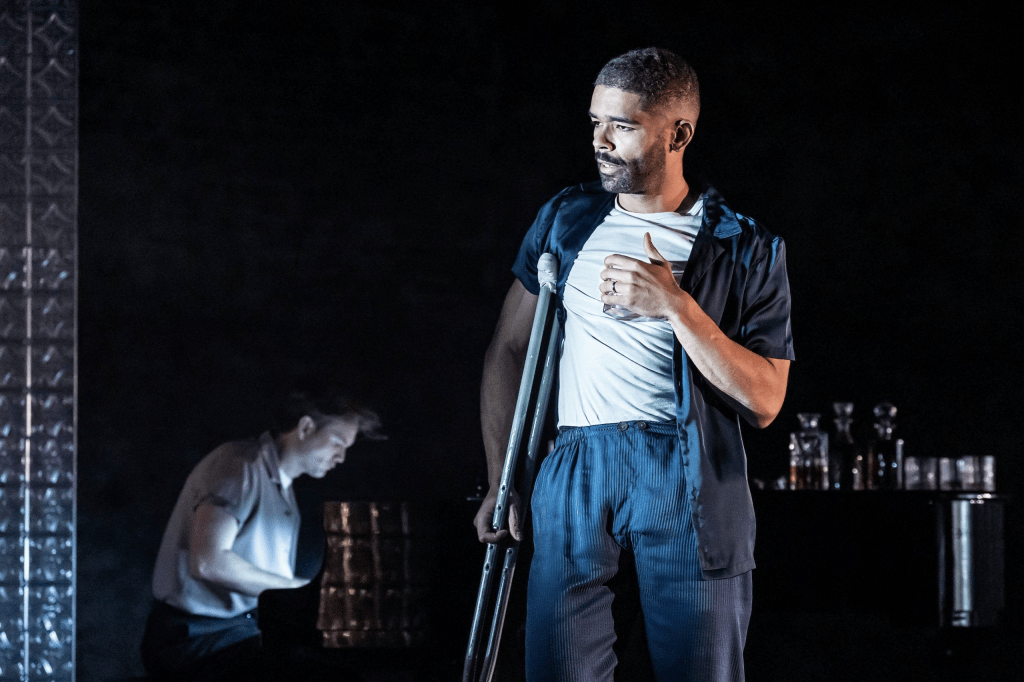
The production is stripped back, leaving plenty of room for the powder-keg explosion of emotions to bounce around the stage. A piano sits in the top corner of stage-right; a young man sits largely unnoticed by those on stage as he occasionally underpins a moment with a musical interlude or clashing of chords. As the action plays out though, it becomes clear that this is not merely a musician here to further eek out the tension, but is perhaps Brick’s dead friend Skipper; his ghost haunting Brick, and taunting Maggie. A genius move on Frecknall’s behalf, as she expertly pulls out the tragedy of this play and these characters.
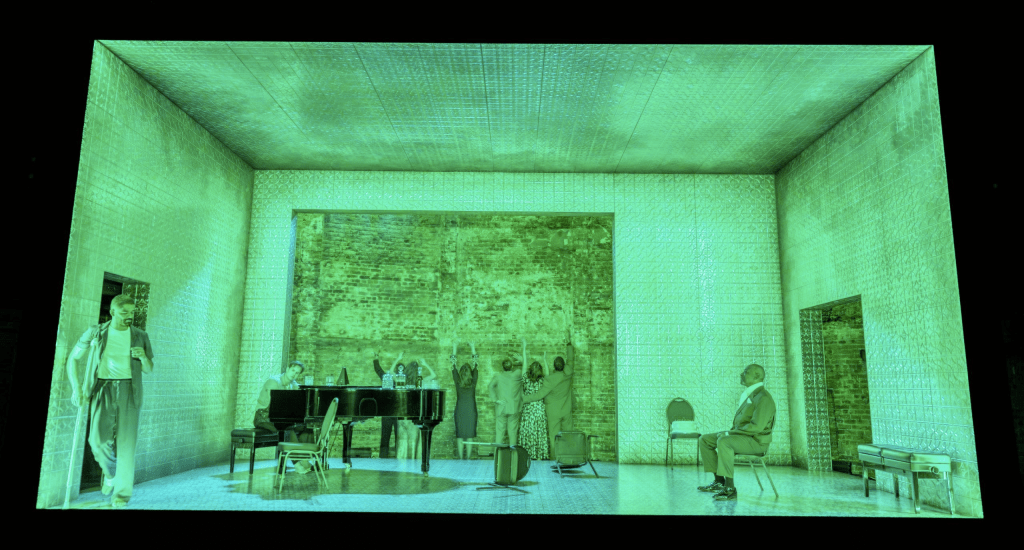
‘I’m not living with you. We occupy the same cage.’ Declares Maggie in Act One. There is a feeling of claustrophobia permeating from the characters – each of them repressed and fighting to break out. Chloe Lamford’s set design mirrors this feeling wonderfully: the action is encased in a metallic-plated box, reflecting the current lighting state (which largely remains cold and white, save for a few visually explosive moments of colour). Behind this, the half-crumbled wall of the Almeida stands, exposed by this set and creating a striking contrast between the smooth silver of Brick and Maggie’s room against a decaying backdrop of America’s Deep South on the precipice of change.
The ensemble cast dazzle and sizzle in their repressed angst. Daisy Edgar-Jones is a fiery Maggie; a different interpretation of the character, which I really enjoyed. The more ‘traditional’ Maggie is played as ever the seductress, using her body and her femininity as her weapon, but here Edgar-Jones is a determined warrior going into battle as she tries desperately to win back the affections of her disinterested husband, Brick. When she plays the ‘ace up her sleeve’ in an act of ultimate manipulation at the end of Act Three, it is a journey that she has carved out for herself from her first word uttered, and it leaves you with immense sympathy for this broken woman who is throwing everything has she left at attempting to get her life back. Though Edgar-Jones takes a little while to fully lean into the character, one can hardly blame her with the everest-level of monologue and exposition she is given in Act One. Clare Burt as Big Mama similarly reinvents Big Mama, grounding her with resolve and making her character all the more tragic in her toxic relationship with Big Daddy. Lennie James as Big Daddy oozes with foreboding as he commands the stage. However, despite these strong performances, if Kingsley Ben-Adir was on stage, it was near impossible to watch anything else – he was utterly captivating. Brick, usually completely detached and stoic, instead circles a light bemusement at watching his world crumble around him – the impact as an audience member is electric. Despair and hopelessness drip from him – no easy feat as he is almost completely silent in the first act, despite never leaving the stage. It was one of the most moving performances I’ve seen in a long time.
This is not a traditional take on an American classic, and nor would you expect it to be with Rebecca Frecknall at the helm. Instead, new life is breathed into the text, a new perspective given to well-known characters. There is not one moment that the tension on stage does not completely grip you; not one moment you aren’t sat forward in your seat in anticipation. It is always exciting to see someone completely reimagine something so embedded within the history of theatre, and even more so when the result is as triumphant as this.


Leave a Reply