📍Young Vic Theatre, London
⭐ ⭐ ⭐⭐⭐
To call Jacob Dunne’s story one of redemption would be to simplify it. In fact, it is a true testament to James Graham’s writing that the two-hour traffic of ‘Punch’ is able to fold so much into its narrative. Yes, the production pulses with its moral messaging from start to finish, but it never veers into something overtly didactic or patronising, and is painfully human.
Based on the real-life Jacob’s memoir, ‘Punch’ is the harrowing yet inspiring true story of Jacob Dunne, a boy from the Meadows estate in Nottingham whose life spirals out of control after a person he punches in a fight, dies. Convicted of manslaughter, he is sent to prison for 30 months. Upon completing his sentence, he faces a fork in the road: carry on living as a delinquent, or make something more of himself. What unfolds is a moving story of the power of social reform, and specifically the restorative justice program. However, it is not just Jacob’s story being told on stage – the parents of James, the one-punch victim, become integral to this process, their grief woven in with Jacob’s own coming-of-age.
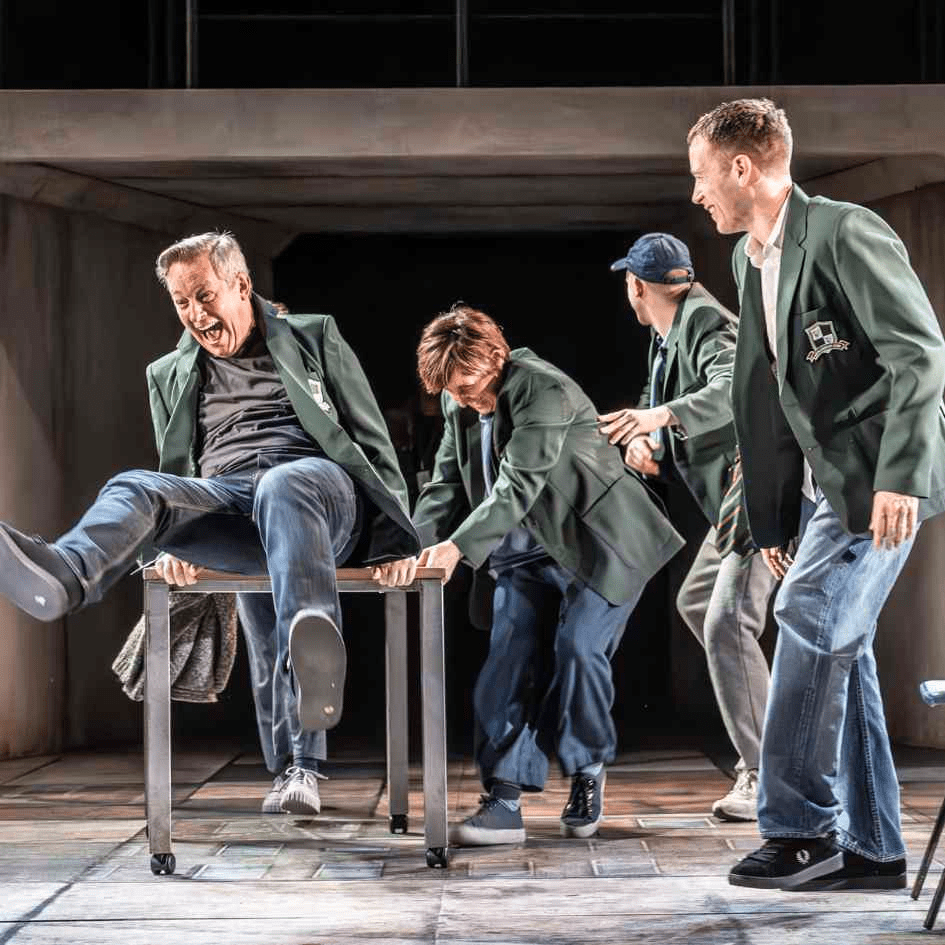
Although the punch is a catalyst for much of the play’s action, we spend a lot of time in Jacob’s formative years in the Meadows. A multi-roling ensemble cast of 6 actors bring Jacob’s world to life: You are completely hooked from the first moments on stage, which begin in a present-day support group as a reformed Jacob begins to describe his out-of-control life as a teenager in Nottingham before the staging sharply pivots back to such a time. From the outset director Adam Penford does a superb job in his staging – the atmosphere is thrillingly vibrant. We are introduced to a cocky, brazen young lad in Jacob – played to perfection by David Shields. The first half of act one is largely expositional, but importantly so, as we need to see the circumstances that Jacob hails from. Not to absolve him from his eventual crime, but to understand the years of context around the one impulsive action of the punch. As Jacob rattles through his childhood in these opening moments on stage, his rhythmic dialogue almost bordering on freestyle rap, the ensemble seamlessly bounce around the stage, creating Jacob’s deprived but busy world.
By the end of the play though, this armour of swaggering cockiness has been stripped away. Shields delivers this transformation beautifully, movingly – it is impossible to get through the last half-hour of the piece without weeping.

There is such a full and electric energy on stage that it is hard to fathom there are only 6 actors involved. Every cast member shines bright in their respective moments, but it is Julie Hesmondhalgh and Tony Hirst as James’s grieving parents who truly stand out alongside Shields. For the most part, the acting style is slightly heightened (partly why the world feels so alive), but with the second act focusing much more on the restorative justice process the acting becomes much more nuanced and naturalistic. This switch into something deeply intimate as Jacob meets James’s parents Joan and David is staggeringly beautiful.
Perhaps the most impressive element of ‘Punch’ (and there are many!) is Robbie Butler’s lighting, and Alexandra Faye Braithwaite’s sound design. Anna Fleischle’s production design, distinctly brutalist with its granite-coloured floor and ramp encircling upstage, is vast and open, leaving the required room for moments of choral movement and some of the most stunning visual design I’ve seen in a long time. Butler’s lighting is bright and bold, and often striking in its beauty. These elements do considerable heavy lifting to paint the stage in its setting: various bars around Nottingham, a chaotic looting during the London riots, and Jacob’s tiny prison cell – all created solely through sound and lighting. Alongside the poetic writing, it makes this play a masterpiece.
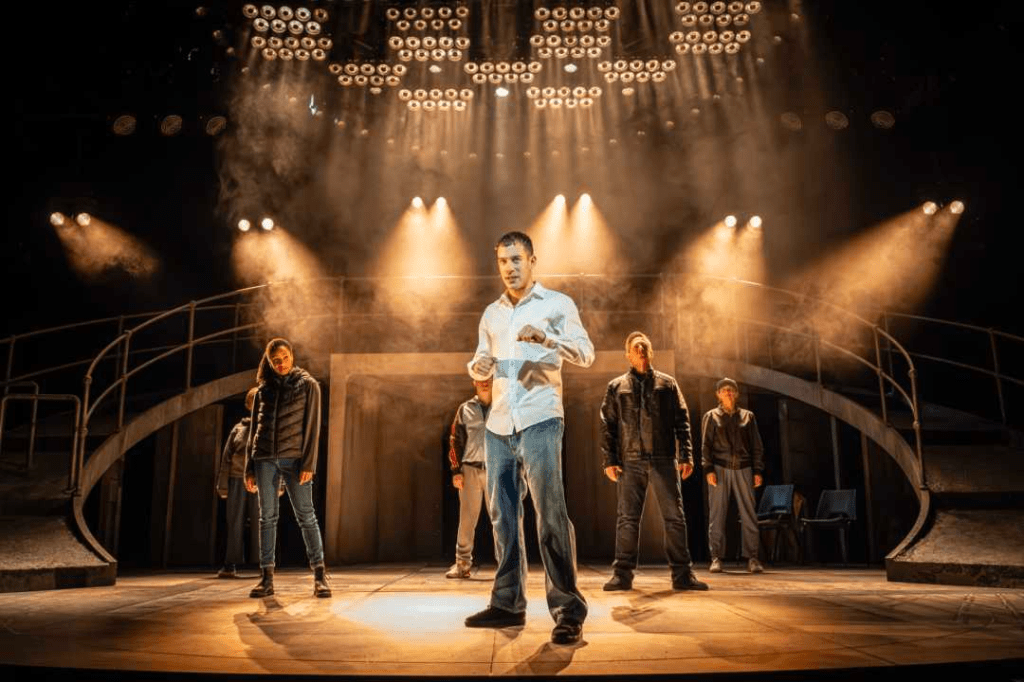
On the more microscopic level, ‘Punch’ concerns itself with the issue of masculinity and the repercussions of this; 19-year old Jacob is fueled by a masculine pride as he swaggers around in his gang. James Graham looks beyond the individual case study of Jacob Dunne though to dissect the world around him – the world that created him. As such, this is a British story of great significance and layered social commentary, forcing us to look at this issue of social and economic deprivation, and the vicious cycle it creates.
‘Punch’ runs until the 26th April at the Young Vic Theatre, and has just announced a West End transfer for later this year!
🎟️Tickets and information: https://www.youngvic.org/whats-on/punch


 Lottie's London Reviews
Leave a comment