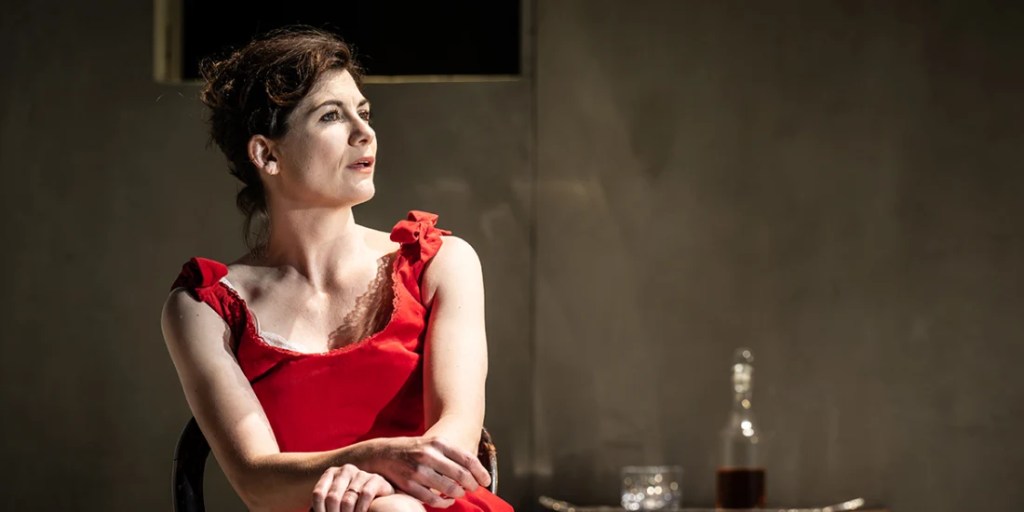
📍Trafalgar Theatre, London
⭐ ⭐
John Webster’s impassioned Jacobean tale of power and misogyny makes a stirring return in a new adaptation by Zinnie Harris, with actor Jodie Whittaker at the helm in the titular role of The Duchess. I had seen Whittaker take on a similarly tragic role in the National Theatre’s Antigone (albeit via online) so was very excited to see her command the stage in another iconic femi-tragic role.
Unfortunately, while Whittaker was an absolute powerhouse, the production itself suffered from an identity crisis, making it difficult to fully connect with the action on stage.
The play opens with a solitary Jodie Whittaker as the Duchess, recently widowed and rejoicing in her freedom from the shackles of marriage. We are then instantly introduced to her brothers and quite evidently the play’s villains; The Cardinal (a sinister Paul Ready) and Ferdinand (a thrillingly manic Rory Fleck Byrne) worry about their sister enjoying this newfound freedom, demanding that she not take up with any other man, lest she taint her reputation (cue eye roll). The Duchess evidently does not listen to this warning as she marries one of her stewards – her accountant – in secret. Having very little previous knowledge of this story, I wondered if it would veer down the path of star-crossed lovers and forbidden romance, but the play is much darker than this as the Duchess’s two brothers devise a plan to thwart their sister, manipulating a downbeat Bosola to infiltrate her palace and report if she is indeed being ‘unfaithful’.
In this new adaptation of Webster’s play, playwright and director Zinnie Harris updates the language by weaving some modern-day grit into the prose. While a few of the most crass phrases sometimes seem to appear out of nowhere, successfully shocking the audience but occasionally causing a nervous titter of laughter in otherwise tense moments, the updated script mostly works well, and feels fitted to the creative vision of the production. In fact, the script helps to make a sharp commentary of the universality of the play’s message in highlighting the enduring danger of brutal misogyny.

Jodie Whittaker is a powerful force on stage, driving through sometimes clunky staging to deliver an impassioned performance; you feel exhausted on her behalf by the end with all she has given to the character. I saw understudy Kerill Kelly as steward Antonio, who was endearingly awkward and brought some lighthearted humour to an otherwise dark and angsty play in act one. Paul Ready and Rory Fleck Byrne as the Duchess’s brothers are villainous archetypes – terrifying as their masculinity invades the stage. Alongside Whittaker, Jude Owusu as Bosola was a standout, delivering rousing soliloquies throughout and managing to wrangle an emotional resolution to the play after an accidentally farcical final scene of gunshots and bloodshed had the audience oddly in hysterics at what was supposedly the emotional climax of the production.
Stylistically, I found this production at odds with itself. The design – a minimalist, grey backdrop reminiscent of a brutalist building, with an upper decking running along the width of the stage – confused high-stakes secretive interactions as these were often delivered with a vast amount of space between actors, causing a lot of the conspiratorial nature of the content to leak out. This set did however easily allow for projections, which are used throughout as a convention to introduce characters in a cinematic manner with their names projected across the backdrop. This helped to frame the objectives of some characters, but once it was repeated for even the smaller supporting roles it had lost its effect by the middle of act one. The main issue however, was in the overall style of the piece. Action is often interrupted by song; confronting violence is depicted on stage but then completely undercut by comic reactions from the audience as blood capsules splatter outwards in all directions during the final confrontation; a particularly odd physical theatre sequence occurs after an intensely unsettling scene of violence, tonally confusing and once again severing the emotional impact delivered by the actors.
In the past, I have often loved productions of classic texts being turned inside out and overhauled for a modern audience. I am hesitant to make the comparison to directors such as Jamie Lloyd, but in many ways this production appears to attempt in achieving the same impact that his past productions have done so. There is an obvious difference though in that Lloyd’s directorial and design choices often successfully derive thematically from the text, whereas The Duchess of Malfi’s staging does a disservice to a story which should feel more vital today than ever before.
🎟️ The Duchess (of Malfi) runs until the 20th December, 2024
Tickets and information: https://theduchessplay.com/#home


 Lottie's London Reviews
Leave a comment