Regent’s Park Open Air Theatre
⭐️⭐️⭐️⭐️⭐️
As soon as the first resonant note of the violin pierces through the atmosphere of the outdoor theatre, prompting an immediate hush over the cheery crowds, we are transported to the small town of Anatevka; a humble place steeped in its traditions – the customs of which are proudly sung out in the show’s opening, ‘Tradition’.
‘And how did these traditions start?’ Tevye proudly asks the audience. ‘I’ll tell you… I don’t know!’ He follows, showcasing the script’s easy humour, a tone which lasts throughout a joyous first half, before expertly transitioning the piece into a tragedy for the musical’s second half.
Fiddler on the Roof first premiered in London in 1967, with Topol in the role as Tevye – a role his name subsequently became synonymous with. Here in Regent’s Park, it is a deserved revival to a musical which feels as poignant and vital today as it had done when first performed in 1964. Fiddler on the Roof follows Tevye, a milkman in a small settlement village called Anatevka in 1905, as he desperately clings to his Jewish traditions – a way of life which the town, and especially Tevye must defend throughout the two acts. His three eldest daughters all want to marry for love, rather than through the village matchmaker as per custom, forcing Tevye to question the link between faith and tradition. While Fiddler is essentially a Jewish story, in current revivals (and certainly this one) it also speaks to the plight of refugees worldwide.
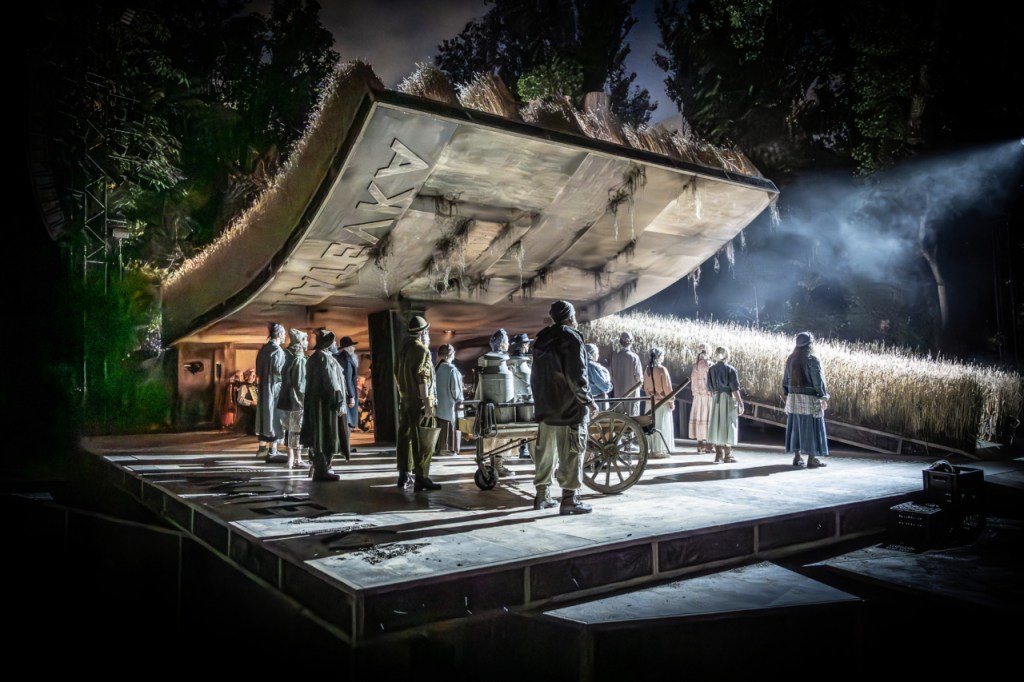
Never has a theatre venue felt more fitting than in conjunction with Tom Scutt’s set design; it were as if Fiddler were written specifically for a theatre nestled between treetops, with birds soaring overhead into a vast skyline. The design, cleverly made to look like a book peeling open, consists mostly of plain wooden surfaces, with an upstage ramp dressed with wheat, mirrored also over the ceiling. These wheat fields jut out of the park, with the immersion also extending to cast entrances over patches of grass surrounding the stage. Anatevka is all around; we are all part of it, but with that, builds the vulnerability of a town desperate to hold on to a way of life, whilst living in the firing line of encroaching outside influences. The result is a thrilling tension which builds as the musical progresses.
A visual highlight came towards the end of Act One, during the haunting ensemble song ‘Sunrise, Sunset’ while Tzeitel (Tevye’s eldest daughter) and Motel are married under a canape. The London sky beyond this tableau faded into rich pinks and oranges, mirroring the somber but beautiful tones of the song which laments the inevitable passing of time. By the end of Act One, when a demonstration by Russians has torn apart the wedding celebration, the sun has set, making way for darker shadows to be cast across the stage as sinister forces tighten their grip on Anatevka, while Tevye himself tries to retain control of his family as his daughters seem to continue to break his beloved traditions.

The casting is flawless. Adam Dannheisser as Tevye, fresh from playing the role over the Atlantic on Broadway, has every ounce of self-deprecating humour and thoughtfulness during his repeated soliloquys. The character is flawed; his enduring trust and devotion in his God can sometimes blind him, but he tries to be a good father, all of which completely endear the audience to him as Dannheisser effortlessly brings to life this complex man. Hannah Bristow, Georgia Bruce and Liv Andrusier are feisty and unabashed as his daughters; these interpretations feel fitting for a modern context. Not graced with many scenes to develop a love story between their respective lovers, their story instead feels one of desiring something bigger than the traditions and confines that Anatevka offers them. They are passionate, curious and bold young women.
Director Jordan Fein, whose notable directorial involvements include the recent Oklahoma! Revival at the Young Vic in 2022 which controversially sexed-up and flipped the original narrative on its head without changing a word of dialogue or song (and was one of my favourite productions of that year), as well as the current West End revival of Cabaret, revitalizes this classic musical for a modern audience. Crucially, there is humour throughout, and though the tone feels less ‘pantomime-esque’ than previous interpretations, it helps build the tension into the second half. After all, for all its joyous atmosphere and catchy songs, the musical’s ending is heartbreaking – from the tear-jerking ballad ‘Far From the Home I Love’, up until the end of the musical, there is little to feel joyful about. The beauty comes from the hope and resilience of Anatevka, which Fein superbly captures on stage as the townspeople of Anatevka look towards an uncertain future with shoulders squared and chins up. The final image is poignant as it is Chava and her clarinet, rather than the fiddle player, left on the roof: the tradition has changed, but faith remains.


 Lottie's London Reviews
Leave a comment